Festival Set-Time Conflicts: Choose a Schedule You Can Actually Follow
A poster lists artists; a set timetable creates choices. Build a short priority list, include real transfer time and decide where a partial set is worthwhile before the crowd makes the decision for you.
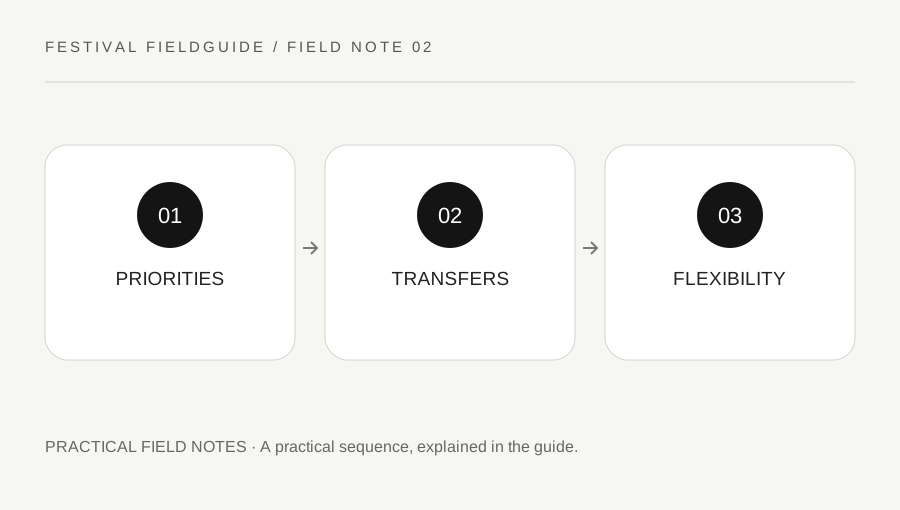
Original explanatory diagram. Examples illustrate a method or decision; they are not claims of personal testing.
Wait for the timetable before fixing the route
A lineup announcement does not establish stage, time or overlap. Use the official timetable for your specific date and edition, and check whether it has been updated. A fan-made image can be useful for discussion, but it should not replace the organizer's current schedule.
Some festivals publish set times close to the event. Coachella's edition-specific information, for example, directs attendees to its official app for timetable releases. Do not treat a prior year's release timing or stage assignment as a promise for a future edition.
Write your preferred artists in three practical groups: must prioritize, would enjoy and optional discovery. This is a personal decision aid rather than a ranking of artistic value. It helps you handle an overlap without pretending that every listed performance can receive equal time.
Add movement and ordinary needs
Mark the stages on the current site map and include travel between them, crowd flow, restroom stops, food and rest. Straight-line map distance does not reveal walking time through an active audience. Avoid assigning one universal transfer duration to every festival.
For a worked example, a priority set ends shortly before another starts across the site. You can leave early, arrive late, choose one complete performance or decide on the day if conditions permit. Write the tradeoff explicitly rather than drawing a route that assumes instant movement.
Consider your viewing preference. A person wanting a particular position may need a different schedule from someone content to listen from farther back. Access needs and companion movement can also change what is realistic. A usable plan fits the group rather than the most ambitious person's pace.
Decide how to handle partial sets
A partial set can be a deliberate choice if you know which performance has priority and when you intend to move. It becomes frustrating when the group repeatedly leaves just as a performance becomes enjoyable because another name appears on the plan.
Agree on a simple decision rule for an overlap. For example, one person chooses a complete priority set while another attends the alternative and reunites at a prearranged point afterward. The rule should include where and when to meet, not rely entirely on messages sent through a busy network.
Leave optional space. An unexpected performance, long queue or weather interruption can change the day. A schedule with no buffer turns a small delay into a chain of missed plans. Keep the priorities visible so the group can simplify without reopening every decision.
Refresh the schedule and protect the exit
Check official updates before leaving accommodation and again when the organizer announces a change. An evacuation, delayed opening or artist change can alter the timetable. Follow staff instructions and the current official schedule rather than a saved image when the two conflict.
Keep the final transport requirement in the plan. A last set that overlaps the only realistic return connection needs a deliberate choice before the day begins. Do not assume that leaving a stage is the same as reaching a pickup point or station.
Finish with a compact version containing priority sets, major transfers and reunion points. The plan should be readable on a small screen or paper without a complicated color key. A good timetable is a set of informed choices with room to adapt, not a claim that every attractive performance can fit into one uninterrupted route.
A practical checklist
Choices are saved in this browser. Reset them here or clear this site’s browser storage.
Questions that come up
Does a lineup poster tell me which acts overlap?
No. Stage assignments and set times require the official timetable. Do not infer them from poster position.
Is leaving every set early the best way to see more?
Not necessarily. It can create constant movement and little time enjoying a performance. Decide which full sets matter most.
Should I keep an old screenshot after a change?
Keep it only as an archive. Use the organizer’s latest instructions and updated timetable for the actual day.
References & scope
Background references checked on 18 October 2026. Worked examples and diagrams are original teaching material.