Festival Accessibility Planning: Turn the Access Guide Into a Day Plan
An accessibility page is a starting point, not a complete personal route. Confirm the services for your ticketed edition, ask specific questions early and connect arrival, stages, rest and departure.
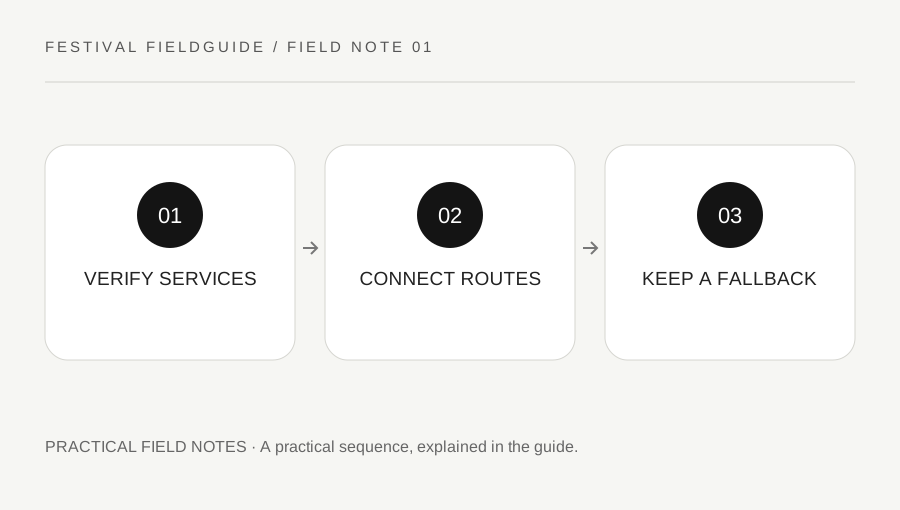
Original explanatory diagram. Examples illustrate a method or decision; they are not claims of personal testing.
Use the correct event and edition
Open the official accessibility guide for the exact festival and dates on your ticket. Festivals with similar names in different countries can use different sites, providers and procedures. An archived guide can help form questions, but it cannot confirm next year's service, entrance or request deadline.
Record the official contact route, any request process and the date you checked it. Do not assume that a general ticket, parking placard or another event's access wristband automatically provides every service. Coachella and Lollapalooza publish dedicated access information, but their details should be read separately.
Make a short list of practical needs rather than sending a vague question about whether the event is accessible. The useful answer may depend on route surfaces, distance, seating, communication support, charging, medication procedures or assistance at a particular part of the site.
Connect the whole journey
Map arrival transport, the appropriate entrance, the access check-in point if required, the stages you want to visit and the departure route. A viewing area can be useful while the route to reach it remains the main planning problem. Consider waiting time and the journey after the last set as well as the headline performance.
Ask the official access team about the specific uncertainty. For example, describe the mobility device and ask about the relevant surface or route, rather than assuming every path matches a promotional photograph. Do not send unnecessary medical records through a general inbox unless the official process explicitly requires particular information.
Keep a simple confirmed-versus-pending table. “Entrance confirmed, shuttle connection pending” makes the remaining task visible and prevents an unanswered question from becoming an assumption in the day plan.
Build space around the schedule
Choose a few priority sets and allow time for movement, rest and service queues. A tightly packed schedule that crosses the site after every performance can undermine an otherwise well-researched access plan. Use the official map and realistic personal travel pace, not a straight-line distance alone.
For a worked example, two desired sets are at opposite stages with a short gap. The plan may prioritize one full set, choose a less demanding viewing position or skip the transfer. The correct choice depends on your needs and the current site, not a universal claim that every stage can be reached in a fixed number of minutes.
Share the practical plan with companions, including whether anyone needs to leave together. Confirm companion policies with the event rather than assuming that every accommodation automatically includes the same number of people.
Keep an on-site route for unresolved problems
Save the access-team contact and identify the official service point on the current map. Keep key confirmations available offline where appropriate, while protecting personal information. If a route or service differs on arrival, ask the designated team rather than relying on a crowd member's confident guess.
Build a fallback that preserves a manageable day: a shorter set list, an earlier departure or a different confirmed route. A fallback is a practical option, not a failure to use the ticket fully. Emergency instructions from event staff take priority over a personal schedule.
After the festival, note what worked and what needs a better question next time. Keep edition-specific answers dated so they do not turn into permanent rules. A good accessibility plan combines official confirmation with realistic movement and rest, giving you more control over the day without pretending that one web page can predict every condition on a live site.
A practical checklist
Choices are saved in this browser. Reset them here or clear this site’s browser storage.
Questions that come up
Does an old access guide confirm next year’s services?
No. Use it only to prepare questions until the relevant edition publishes or confirms its arrangements.
Should I assume companion access is identical everywhere?
No. Read the particular event policy and confirm what applies to your ticket and requested service.
Is a stage viewing area the whole accessibility plan?
No. Entrances, surfaces, travel, waiting, rest and departure can be equally important.
References & scope
Background references checked on 18 October 2026. Worked examples and diagrams are original teaching material.